My thesis over the past six months has become more confident.
- In November 2023 and December 2023, after observing signs of an early inflation rebound/unanchored starting in September 2023 and noting significant evidence in November, as I reported at the time, I was quite confident that inflation would pick up within 4 to 11 months from November. At that point, almost no economists were discussing a potential rebound/unanchored in inflation. I believe this was a major oversight in their understanding of economic principles, failing to recognize this very important indicator. Without the ability to recognize this initial part, supported with China activity indicators, we may just simply miss the rest. In November, I was very critical to many economists opinions about the unanchored threat. As of December 2023, it became clear to me that the global PMI was rebounding and acute EM easing confirming the unanchored inflation risks at a time when the world was busy anticipating six rate cuts and got drunk with lower inflation expectation. My predictions about the global PMI was proven correct in April 2023, which refuted the likelihood of rate cuts and highlighted the unanchored risks of inflation. The focus on easing in emerging markets was also correct, as evidenced by the drama surrounding the Bank of Japan (USDJPY) and many falling currencies in emerging markets in April 2024.

- In my January 2024 thesis, I noted that despite the market’s eagerness for six rate cuts, based on my historical experience and intuition, this expectation seemed contradictory. If I was confident that inflation would rebound, why would the market expect six rate cuts in December? This question troubled me non-stop during my long hours flights in January. Furthermore, after considering many other factors, I concluded that if the market still expects rate cuts so urgently, the Federal Reserve should not cut rates before beginning to taper. This is not only illogical, but also excessive.
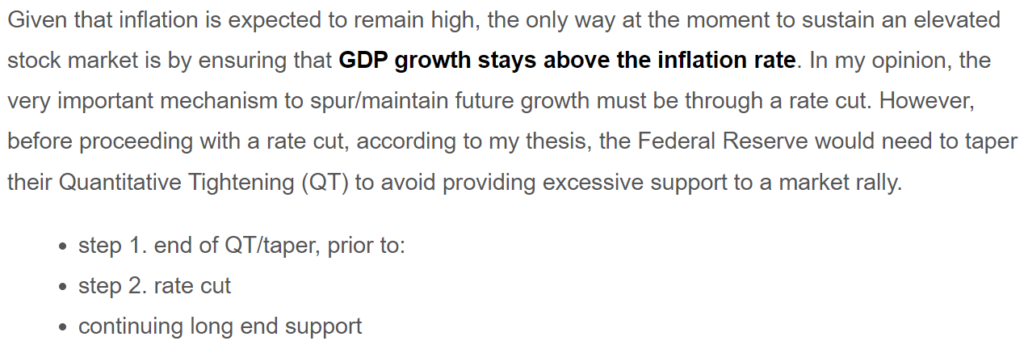
- I continued to emphasize the importance of tapering from April 2024 until the final hour on May 2nd, just before the Federal Reserve’s decision.

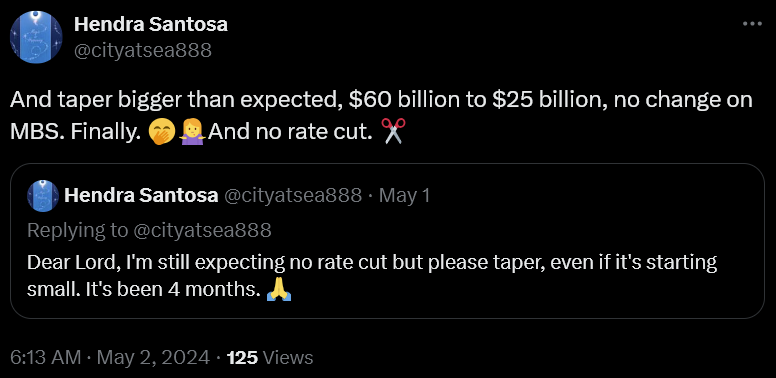
- Due to this, the rate cut should take more time as it needs more time to develop the taper. The indication of tapering was clearly seen as early as April 23rd. For me, tapering could be a very important factor. It may signal the bottom of asymmetrical tightening stress testing, which represents the maximum stress that the global economy can sustain in the long run.

- Both of the above predictions were correct. The markets ignored the rate cuts, and tapering began in May, before any rate cuts. Clearly, the markets had misjudged the market dynamics since October/November 2023. If their analysis was off the mark as early as October 2023, failing to notice the clear signs of inflation rebounding, I do not think market will be able to reach the same conclusion as mine—that tapering should occur before any rate cuts.
To continue with my comprehensive thesis, I am someone who always use adaptive principle. As the principle of machine learning suggests, some of my points among plenty of them might be incorrect, and I am willing to adjust them over time as more evidence becomes available. Within the existing grand framework of my thesis:
- Strong economic numbers.
- Continued support for the long end of the market.
- Taper ~ 450B$
- Treasury buyback – starting small
- Shorter-duration issuance, in support of higher inflation.
- Strong real inflation numbers, though they or their non-real may be lower over time, will be observed.
- Sufficient liquidity at the short end of the market.
If any of the above fails, the Federal Reserve will still be able to cut rates, countering a potential shift to a very strong bullish steepening curve. Of course, it would be quite interesting to see whether using an atomic bomb to kill a cockroach is justified. However, it comes back to my principle: market participants are greedy (either to long upside or short downside). Therefore, let’s observe further developments.
Within this framework, I think yields may ease, not necessarily drop, and this will be accompanied by an easing, not necessarily weak, of the USD.
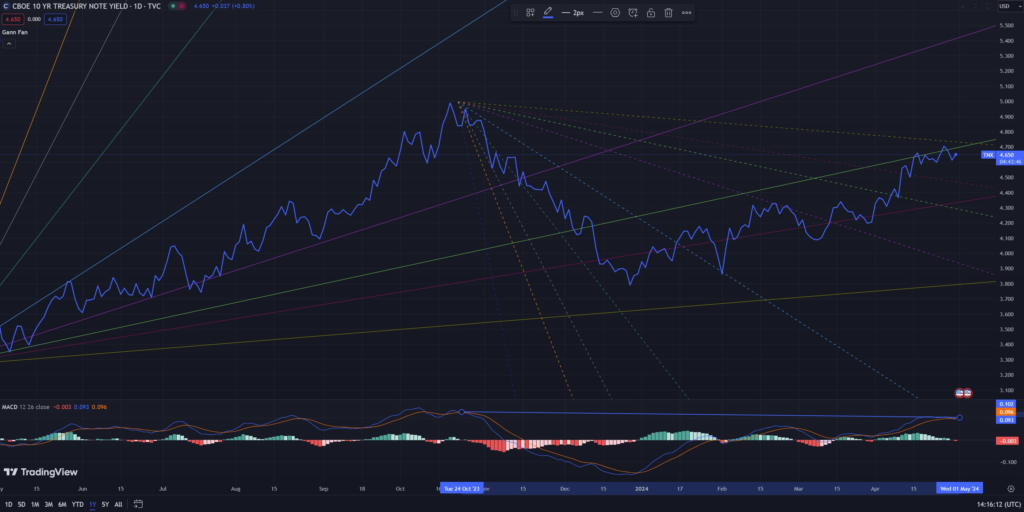
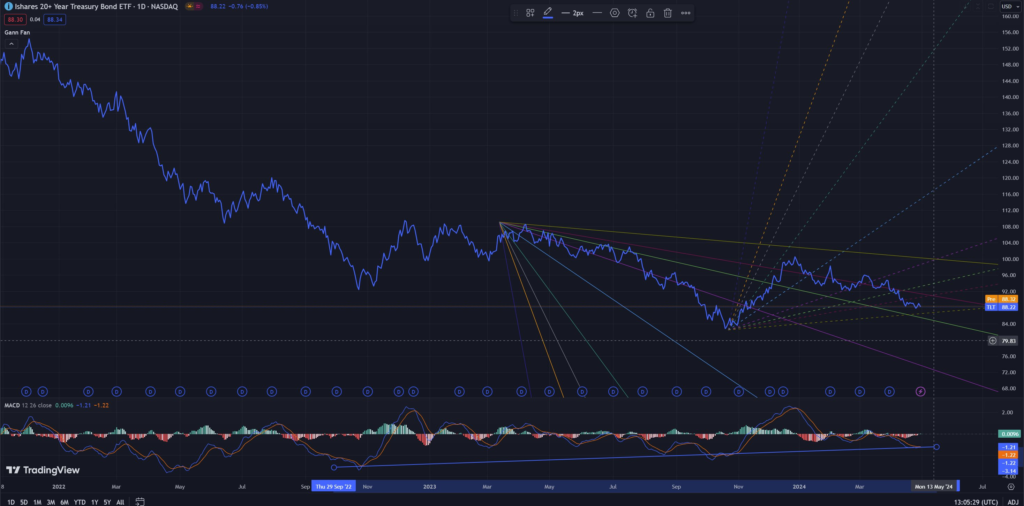
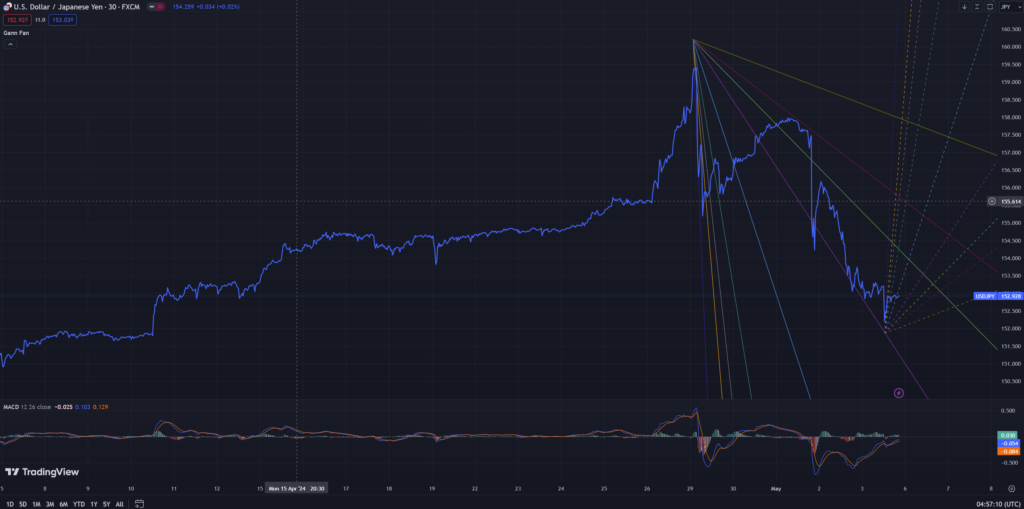
The overall scenarios outlined above clearly align with the movements in Bonds and USDJPY. The dynamics of Bonds and USDJPY have been reinforcing my thesis, particularly with the support of the Bank of Japan (BOJ). Before the policy change, it was clear that countries outside the US were struggling to combat capital outflows to the very attractive returns in the US (very high 5.5% return with least risk), which led me to keep my hedge tight with emerging markets as their currencies faced difficulties.
In April 2024, policymakers signalled an imminent policy change, which I observed through numerous pieces of evidence towards the end of April.
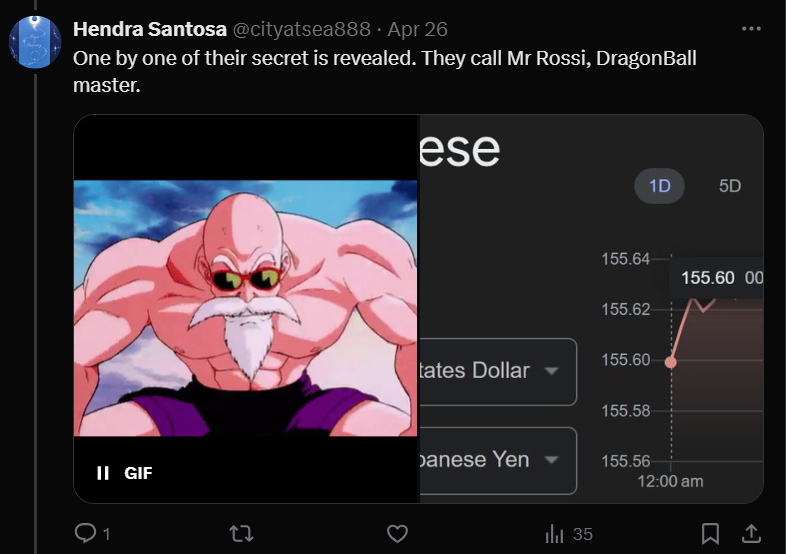
As a result, I believe that with the policy change, which supports my overarching framework, the Bank of Japan (BOJ) will find it easier to intervene. This is reinforced by the tapering I anticipated. I’m not suggesting that the turmoil in USDJPY is over, but it should be more manageable with the policy change.
In relation with factor from US borrowing side, mainly for Q3, more details are available from one of the best sources, who has kindly shared his extensive knowledge: https://johncomiskey.substack.com/p/qra-borrowing-estimates-retrospective. Clearly, things are complex, and detailing the entire framework is challenging without many years of understanding that the market is always dynamic, and we should never remain static.
In developing my thesis, I feel that it is never enough to achieve more, learn more, and adapt more. There is much more to develop in this story, though I try to keep it simple. Meanwhile, enjoy this weekend with more music.
♬ I’m trying to hold my breath
Let it stay this way
Can’t let this moment end
You set off a dream in me
Getting louder now
Can you hear it echoing? ♬
♬ All the shine of a thousand spotlights
All the stars we steal from the night sky
Will never be enough
Never be enough
Towers of gold are still too little
These hands could hold the world but it’ll
Never be enough
Never be enough ♬
♬ For me
Never, never
Never, never
Never, for me ♬
Please note that all ideas expressed in this blog and website are solely my personal opinions and should never be considered as financial advice.